
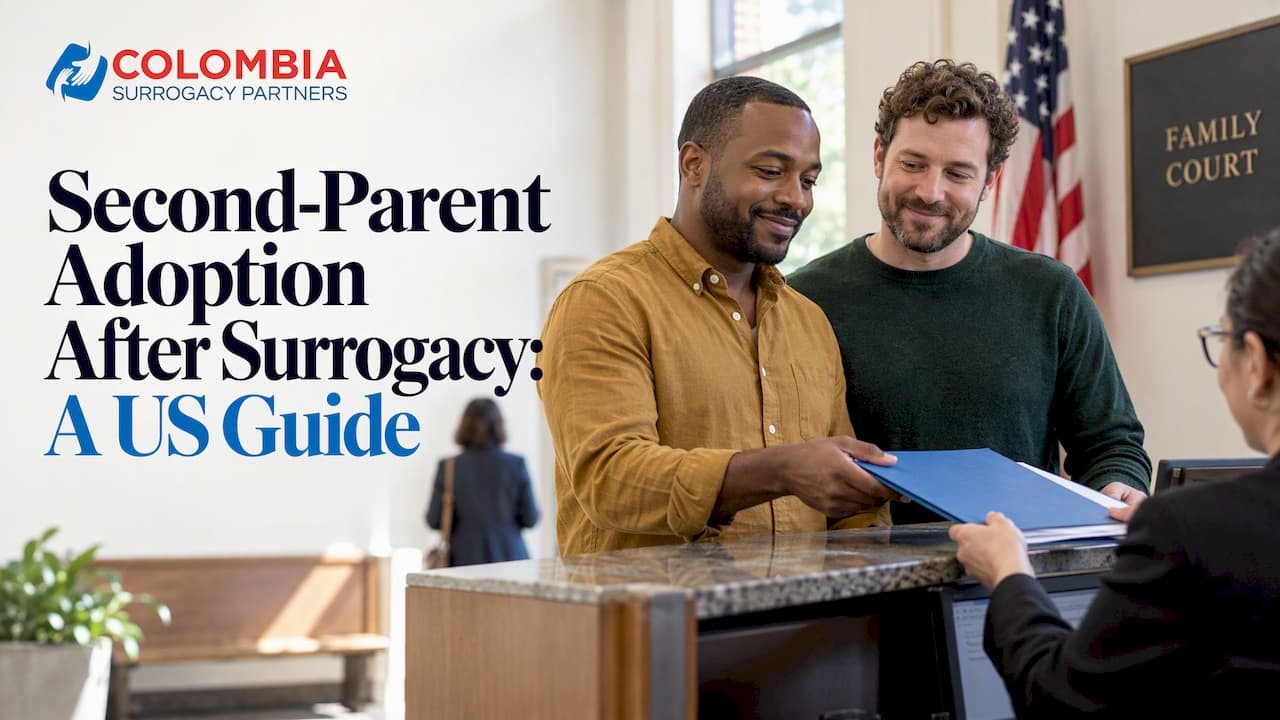
Second-parent adoption is a court process that gives the intended parent who is not genetically or legally related to a child a court-ordered, permanent legal parent-child relationship. After surrogacy, many families pursue it so that both parents hold a decree that every US state must honor, even when the birth certificate already lists both names. This guide explains what the adoption does, the requirements you will usually meet, how the steps run, and what changes when your child is born in Colombia.
TL;DR
- A second-parent (or co-parent) adoption establishes the non-biological parent's rights through a court judgment, which is stronger than a birth certificate alone.
- Requirements vary by state. Expect a petition, background checks, supporting documents, a filing fee, and sometimes a home study, references and a hearing.
- Married couples can use stepparent adoption in every state. Unmarried couples and some LGBTQ+ families depend on whether their state allows true second-parent adoption.
- For a child born in Colombia, parentage is registered differently than in the US, so confirm citizenship documents first and plan the US adoption with a family law attorney in your home state.
Table of Contents
- What second-parent adoption does after surrogacy
- Who needs it, and who may not
- How state law changes the answer
- Requirements you will typically meet
- The steps, in order
- When your child is born in Colombia
- Our perspective
- How we can help
- Common mistakes to avoid
- FAQ
- Sources
What second-parent adoption does after surrogacy
Second-parent adoption, also called co-parent adoption, is the legal process of adopting a partner's child when you are not biologically or legally related to that child. Harvard Health describes it as a way to create a legal relationship without the first parent giving up any rights. The American Bar Association explains that it secures the non-biological parent's rights wherever the family travels or lives.
The reason to do it even when you are named on a birth certificate is enforceability. Family Equality notes that an adoption judgment provides additional security for parentage, and that a birth certificate alone does not conclusively establish it. Under the US Constitution, valid court judgments, adoption decrees included, must be recognized by all states and jurisdictions. A birth certificate is an administrative record, and a decree is a court order.
In practice, the decree matters in moments you hope never to face:
- A medical emergency in a state or hospital that does not recognize your relationship.
- A separation, a death, or a dispute with extended family.
- Travel, school enrollment, inheritance and insurance questions.
- A change in law or political climate in your state.
For families with one genetic parent and one non-genetic parent, the adoption protects the second parent. For single parents by choice, there is no second parent to adopt, but the same logic applies to securing the first parent's status in the US court system when a foreign document is the starting point.
Who needs it, and who may not
Not every surrogacy family needs the same order. The right path depends on how parentage was established, where the baby was born and whether you are married.
| Situation | Typical path | Why |
|---|---|---|
| Same-sex or different-sex couple, one genetic parent, child born abroad | Second-parent or stepparent adoption for the non-genetic parent | The genetic parent is the legal parent, so the partner needs a decree |
| Married couple, both named on a US birth certificate or court order | Often a confirmatory adoption for extra security | A judgment is the strongest proof of parentage |
| Unmarried couple | Second-parent adoption, only where the state allows it | Stepparent adoption generally assumes marriage |
| Single parent | Usually no second-parent adoption | There is only one legal parent |
This table is a general map. A family law attorney licensed in your state decides which route fits, and some attorneys recommend a decree for every family, regardless of how the birth certificate reads.
How state law changes the answer
This is the part that decides your strategy. According to Family Equality, stepparent adoption is available to married couples in every state, while second-parent adoption is available to unmarried couples only in some. Local laws and options vary. An ACLU state summary draws the same line: some states allow second-parent adoption regardless of marital status, and others limit it to married couples or those in a civil union or domestic partnership.
For married couples, the practical advice is simple. Marriage opens the stepparent route everywhere, so couples who are planning surrogacy and who have not yet married should talk to their attorney about timing before the baby is born, because the order of events can affect which forms you use.
California shows how streamlined a state can make this. Its court self-help site says spouses or domestic partners who were together at the child's birth and remain together can use a simplified stepparent adoption to confirm parentage after assisted reproduction or gestational surrogacy, and it lists a specific declaration form for gestational surrogacy cases where the child was born outside the state. Other states use different forms, different names for the same process and different review steps.
If you live in a state with limited options, your attorney may talk about alternatives such as a parentage judgment, or about whether to file in a different state where you have a real legal connection. That is a legal decision with jurisdiction rules, and it needs a local lawyer, not general advice.

Requirements you will typically meet
Requirements differ by state and by county, but Family Equality reports that the same elements recur: an adoption petition, background checks, supporting documentation, a filing fee, and in some places home studies, references and a court hearing.
Colorado's judicial branch gives a concrete example. Its instructions for second-parent adoption set an age minimum of 21 for the petitioner and call for FBI and state background checks along with filing fees. Your own state's court website will have its own list, and the numbers will differ.
A working checklist to start gathering:
- Proof of identity for both parents, and the child's foreign birth certificate with a certified translation if it is not in English.
- Proof of the parent-child link for the legal parent, such as the court or registry documents that name them.
- Marriage certificate or domestic partnership proof, if you are using a route that requires it.
- Surrogacy and donor paperwork, including the surrogacy agreement and any consent or relinquishment documents.
- Background check results as your court requires them, often including fingerprints.
- Proof of residence and, where required, a home study or references.
- The filing fee, or a fee-waiver request if your court allows one.
Courts mostly decide on one question. As the model legal brief by Suzanne Bryant explains, judges consider whether the adoption is in the child's best interest, and a second-parent adoption supports that by giving the child clear legal, psychological and economic ties to both parents. In most surrogacy cases where the family is stable and the paperwork is complete, the hearing is brief.
The steps, in order
The order below is a typical outline. Your attorney will adjust it to your state.
- Consult an attorney in your state before the birth. Family Equality recommends working with a qualified family law attorney in your own state, because local adoption and parentage law is complex. Ask which route applies to your marital status and how a foreign birth is handled.
- Confirm what the birth country will issue. The birth certificate, the surrogate's consents and any court orders shape the petition.
- Secure the child's US travel documents. See the next section.
- Return home and establish residence in the state where you will file.
- Prepare and file the petition with the court clerk, with background checks and supporting documents.
- Complete any home study or reference step your court requires.
- Attend the hearing, where the judge reviews the file and signs the decree.
- Request certified copies of the decree and, where your state allows, an amended birth certificate. Keep the originals with your safe documents.
Timelines and fees depend on the county and on the complexity of the file, so ask your attorney for a range instead of relying on a national average. If a source gives you a single number for all states, treat it with caution.

When your child is born in Colombia
Colombia adds a layer, because parentage is recorded under Colombian rules before any US court gets involved. A 2026 HCCH study on birth registration after surrogacy reports that Colombia has no specific federal surrogacy statute, that the surrogate is typically registered as the mother at birth, and that intended parents may need to challenge this in court to be recognized. It also notes that court rulings on registration can be inconsistent. The same document points to case law such as the 2015 Constitutional Court ruling SU-696, which protected the right of children born to diverse families to be registered.
The HCCH study adds a point that matters directly to this topic: because regulation is limited, arrangements in Colombia are often structured so that parentage passes to one intended parent, and a second-parent adoption may then be needed later in the United States. That is why many couples, especially same-sex couples and unmarried couples, plan for a US adoption from the start.
For background on the Colombian side, our guides on whether surrogacy is legal in Colombia and how the process works step by step cover the legal setting and the stages in more detail.
What to verify before you fly home
The US State Department decides your child's citizenship when you apply for a Consular Report of Birth Abroad or a passport. According to its page on surrogacy abroad, officers may ask for evidence of the relationship, such as a US citizen father who is the child's genetic father, or a US citizen parent who is not genetically or gestationally related but is married to a parent who is, at the time of the birth. The same page warns that when fully donated genetic material is used, the child might not obtain US citizenship at birth because neither parent has a biological relationship to the child.
Before you leave Colombia, check each of these with your attorney and the embassy's current instructions:
- Genetic link. Which parent will the State Department treat as the genetic or legal parent, and what evidence will it want?
- Marriage timing. The rules for a non-genetic parent turn on marriage at the time of birth, so the marital status you have on the birth date matters.
- Birth registration. Is the Colombian birth record final, and does it match the names on your other documents?
- Surrogate consents. Do you hold signed, dated copies of every document the court or embassy may ask for?
- Translations. Are certified translations ready for the US court?
- The US filing plan. Which court will hear the adoption, and what residency is required to file there?
Certain details here, such as which documents the embassy accepts, can change. Use the State Department page above and your attorney as the current word, not a blog post, including this one.
Our perspective
We work with intended parents who come from many family structures: gay and lesbian couples, transgender couples, heterosexual couples, single parents, cancer survivors and HIV-positive parents. Families in each of these groups ask us the same question in different words: "Will both of us be legally recognized as our child's parents once we are home?"
Our answer is that the birth country gives you the starting documents, and the US court gives you the lasting protection. We treat the second-parent adoption as part of the plan from the first consultation, not an afterthought once the baby arrives. Colombia's framework rests on case law and court practice rather than a single surrogacy statute, so we think the careful route is the one that assumes a US decree will follow, and prepares for it: the right consents, the right genetic-link planning, and a family law attorney in your home state who has done this before.
Our team includes legal experts and medical professionals, some with personal surrogacy experience, and we have supported more than 60 live births. What that experience has taught us is practical. Families who ask about their state's rules early make better decisions about marriage timing, documents and travel than families who ask after the birth. We encourage that conversation to happen before you sign anything.
— Florent Letronne, PhD
How we can help
If you are weighing surrogacy in Colombia and want a clear view of the legal path back to the United States, our team can walk you through the process and the documents involved. You can start from our surrogacy overview, or go directly to the page for your family: gay couples, lesbian couples, transgender couples, heterosexual couples, singles or international couples. Our pages on international versus US surrogacy and affording surrogacy can help you compare options before you commit.
We coordinate the surrogacy journey. Your US adoption itself is handled by an attorney licensed in your state, and we encourage you to choose one early.
Common mistakes to avoid
- Relying on the birth certificate alone. It is useful, but a judgment gives more security.
- Assuming every state treats unmarried couples the same. Second-parent adoption for unmarried couples is available only in some states.
- Ignoring marriage timing. Citizenship and adoption routes can depend on the couple's marital status at the time of birth.
- Waiting to hire an attorney. Consult one before the birth, not after you land.
- Using a single national estimate for cost or timing. Fees and schedules are set by your court and your attorney.
FAQ
Is second-parent adoption the same as stepparent adoption?
They are close relatives. Stepparent adoption is open to married couples in every state, while second-parent adoption, which does not require marriage, is available only in some states. Your attorney will name the right label for your court, and the forms may differ.
Do we need it if both of us are on the birth certificate?
Many attorneys still recommend it. A birth certificate does not conclusively establish parentage, while an adoption judgment provides additional security and must be recognized across all states.
What are the requirements for second-parent adoption?
They vary by state, but usually include a petition, background checks, supporting documents and a filing fee. Some courts also ask for a home study, references and a hearing. Check your state court's website and confirm with your attorney.
Will Colombia's recognition of us as parents be enough in the US?
Do not count on it. Colombian registration practice varies and the surrogate is typically registered as the mother at birth, so a US court order may still be needed for the non-genetic parent. Plan the adoption with your attorney before you travel.
Can single parents use second-parent adoption?
Usually not, because there is no second parent to adopt. Single parents should still speak to a family law attorney about how the foreign birth documents are recognized and whether a confirmatory judgment makes sense in their state.
Sources
- Assisted Reproductive Technology Law: 10 FAQs, American Bar Association
- Co-parent adoption: A critical protection for LGBTQ+ families, Harvard Health
- Securing LGBTQ+ Parentage by State, Family Equality
- Stepparent adoption to confirm parentage, California Courts Self-Help
- Instructions for Second Parent Adoption, Colorado Judicial Branch
- Second Parent Adoption: A Model Brief, Duke Law
- State adoption law summary, ACLU
- Registration of births of children born through surrogacy, HCCH
- Assisted Reproductive Technology (ART) and Surrogacy Abroad, US Department of State