
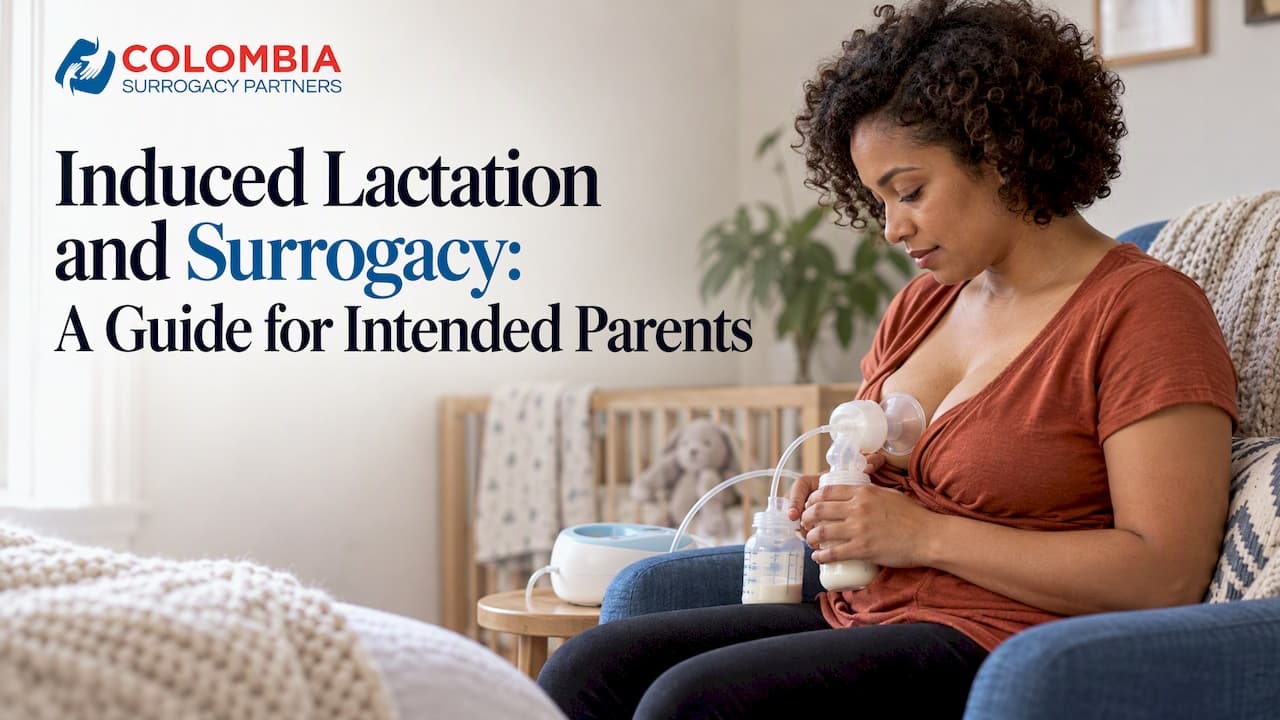
Yes, many intended parents who did not carry the pregnancy can breastfeed or chestfeed their baby. Induced lactation uses a mix of hormone therapy, medication and frequent breast stimulation to bring in milk without pregnancy. It works best when you start months before the birth and plan with a physician and a lactation consultant. For most intended parents, a partial milk supply plus formula or donor milk is a realistic and successful result. This guide explains how the process works, how to set expectations, and what to do about breast milk when your baby is born in Colombia.
TL;DR
- Induced lactation does not require pregnancy, a birth or fertility. La Leche League International explains that prolactin and oxytocin respond to consistent stimulation, whatever your gender or reproductive history.
- Protocols usually combine hormonal preparation, sometimes a galactagogue medication, and pumping 8 to 10 times a day. Medication is not first-line therapy, and stimulation is the core of the plan.
- Many parents with good support see milk within 6 to 8 weeks of starting. A full supply is not the standard for success: bonding and nursing at the breast count most.
- Start with your physician and an IBCLC well before the transfer or the expected delivery date, and plan for supplementation from day one.
- Expressed milk can go through US airport security and be stored under Colombian health ministry guidelines, so plan storage before you travel.
Table of Contents
- What induced lactation is and who it is for
- How induced lactation works
- A realistic timeline for surrogacy
- Setting expectations: milk volume versus connection
- Breastfeeding after surrogacy when you do not induce lactation
- Bringing breast milk to and from Colombia
- Our perspective
- How we support you at Colombia Surrogacy Partners
- Questions to bring to your first appointments
- FAQ
- Sources
What induced lactation is and who it is for
Lactation is a physiological response, not a reward for pregnancy. According to La Leche League International, the pituitary gland releases prolactin and oxytocin when breast tissue is stimulated. That is why adoptive parents, intended parents through surrogacy, partners of birthing parents and trans women have all been able to produce milk.
In surrogacy, the people who ask about it include:
- Intended mothers in heterosexual couples, especially those who cannot carry a pregnancy, such as cancer survivors.
- Lesbian couples, where the partner who did not provide the eggs, or both partners, may want to nurse.
- Trans women who want to nurse their baby, which medical teams increasingly support. A 2024 endocrine protocol was developed for women with endocrine conditions, surrogate mothers and same-sex couples.
- Single mothers by choice who want the nursing relationship.
Gay fathers and other intended parents who do not want to induce lactation still have many ways to feed and bond with their baby. We cover these below.
The research on surrogacy specifically is small. A 2001 case report described a successful induction in a commissioning mother, and a 2017 case report followed a 39-year-old intended mother through galactagogue drugs, mechanical stimulation and a measured outcome. Larger studies exist for non-gestational mothers in general, such as a 2025 study in Iran on outcomes and predictors of success. Treat the evidence as encouraging but limited, and expect your clinicians to individualize the plan.
How induced lactation works
Most protocols have two parts: preparing the breast tissue, then stimulating it the way a newborn would.
Hormonal preparation
According to La Leche League International, protocols typically mimic pregnancy with hormonal therapy, such as combined oral contraceptives, to stimulate breast tissue development. A physician starts this several months before the baby is due. A provider writes the prescription, and the AAP chapter on induced lactation says that estrogen or progesterone is prescribed when the parent has months to prepare.
You should not start this on your own. Hormone therapy has health considerations that depend on your history, including any cancer treatment. If you are a cancer survivor, your oncologist should be part of the decision before anything is prescribed.
Galactagogue medication
Some protocols add a galactagogue, a drug that raises prolactin, such as domperidone. The 2017 case report used metoclopramide and domperidone in sequence. Lactation specialists point out that these drugs have possible side effects and inconsistent results, so they should not be the first line of therapy. Ask your prescriber what each drug involves for you and whether you need it at all.
Frequent stimulation
This is the part nobody can skip. The most effective way to build supply is frequent breast emptying, often 8 to 10 times in 24 hours, which mimics a newborn's pattern (La Leche League International). For comparison, ACOG notes that an average feeding frequency of 8 to 12 times per day is typical for a breastfed infant.
In practice, that means a hospital-grade pump, a schedule you can keep, and a partner or friend who protects your sleep. The same sources report that parents who have proper support often begin producing milk within 6 to 8 weeks of starting.

A realistic timeline for surrogacy
Surrogacy gives you something many adoptive parents lack: a known timeline. Once the embryo transfer is confirmed and the pregnancy is progressing, you can count back from the expected delivery date. The table below is a planning frame, not medical advice. Your clinicians set the real schedule.
| Stage | What to do | Who to involve |
|---|---|---|
| Before or at transfer | Ask whether induced lactation is right for you. Review your health history, medications and any cancer treatment | Your primary physician, endocrinologist or OB-GYN, oncologist if relevant |
| First trimester | Find an IBCLC with induced lactation experience. Decide on your goals | IBCLC, your fertility clinic |
| Several months before the due date | Begin the hormonal preparation your physician prescribes | Prescribing physician |
| About 6 to 8 weeks before the due date, or earlier | Start regular pumping, building toward 8 to 10 sessions a day. Add a galactagogue only if your physician recommends it | IBCLC, prescriber |
| Birth and first days | Plan skin-to-skin contact, and have a supplemental feeding plan ready | Pediatrician, IBCLC |
| After birth | Nurse at the breast, supplement as needed, and adjust with your IBCLC | IBCLC, pediatrician |
Babies born earlier than expected do happen, so give yourself a buffer. If your delivery date comes sooner than planned, your plan still works: any amount of milk and any amount of nursing counts.
Setting expectations: milk volume versus connection
Many intended parents are surprised to learn that clinicians do not measure success by ounces. Medical professionals emphasize a high likelihood of needing formula supplementation, and they advise treating partial milk production as a successful outcome (2017 case report).
There are really two goals, as the Canadian Breastfeeding Foundation describes: getting your baby to breastfeed, and producing breast milk. You can succeed at the first without the second.
Supplemental nursing systems
A supplemental nursing system (SNS) is a device with a thin tube taped to the breast. Your baby receives donor milk or formula through the tube while nursing, so feeding is complete and the baby still gets the breast. La Leche League International describes it as a way to keep the connection going while your supply is limited or still developing.

Protecting your emotional wellbeing
This process is demanding. Pumping around the clock while preparing for a baby and, often, an international trip is a lot. Expert guidance stresses empathetic professional support so that you do not feel you have failed if exclusive breastfeeding is not reached. Tell your care team early that bonding is your priority, and ask them to judge the plan by that.
La Leche League also notes that newborns are wired to initiate breastfeeding, and that patience and skin-to-skin contact can help even older infants learn to nurse. That is reassuring if your baby first meets you a few days after birth.
Breastfeeding after surrogacy when you do not induce lactation
Inducing lactation is a choice, not a requirement for bonding. Some intended parents decide against it for medical reasons, for time or because it does not feel right. Other options include:
- Bottle-feeding with formula or donor milk, using paced feeding and eye contact.
- Skin-to-skin contact from the first hours, which any parent can do.
- Taking on night feeds and bath time so the baby learns your voice and smell.
We wrote more about this in how to bond with your baby after surrogacy.
Bringing breast milk to and from Colombia
If you or your surrogate pumps milk, or you want to bring your own expressed milk with you, the logistics matter. Plan around three questions: how you store it, how you carry it, and what you are allowed to bring through airport security.
Storing milk in Colombia
The Colombian Ministry of Health gives these limits for fresh, unpasteurized expressed milk: up to 4 hours at room temperature in a covered container, up to 12 hours refrigerated, and up to 15 days frozen. Ask your hotel or apartment for a refrigerator with a freezer compartment before you arrive, and check what your accommodation provides.

Flying home to the United States
The TSA states that breast milk in quantities greater than 3.4 ounces (100 ml) is allowed in carry-on baggage and does not need to fit in a quart-sized bag. You must remove it from your bag to be screened separately. Tell the officer you are carrying it before screening starts.
The CDC advises that freshly expressed milk can travel in an insulated cooler bag with frozen ice packs for up to 24 hours. After you arrive, use the milk right away, refrigerate it or freeze it.
Milk from your surrogate
Some surrogates offer to pump for the baby. This is a personal and medical decision that involves her health, her consent and your pediatrician's advice. Raise it openly with your surrogacy team, and ask the pediatrician what screening or handling applies before you accept. We would never expect a surrogate to feel obliged to pump.
Practical travel checklist
- Confirm your pump is compatible with Colombian voltage, or bring an adapter and a battery option.
- Pack more insulated bags and ice packs than you think you need.
- Label milk with the date and time it was expressed.
- Keep a short letter from your physician or IBCLC explaining that you are inducing lactation.
- Arrange refrigerator and freezer access before you land.
- Allow for the legal exit steps and the wait before flying home with the baby. See our legal process overview for what that involves.
Our perspective
We work with intended parents from many family structures, and the question of breastfeeding comes up more often than people expect. It tends to arrive late, often after the transfer, when the parents begin imagining the first days with their baby. We would rather it arrive early.
Our view is simple. First, induced lactation is a legitimate choice with real support behind it, and every intended parent should hear that it is possible. Second, it is optional, and no parent bonds less with their baby for not doing it. Third, the plan should be built by clinicians in your home country who know your health, because those are the people who will prescribe, monitor and follow up.
In Colombia, surrogacy takes place under legal protections meant to keep the process safe and altruistic, and our clinic is highly rated. Our team includes legal and medical professionals, and some have personal surrogacy experience. That is why we try to raise topics like lactation, travel logistics and post-birth care at the start, not the end. We have supported more than 60 live births, and we have learned that parents who plan feeding and travel early arrive calmer.
If you are a gay or trans parent, a single parent or a cancer survivor, your path may include different questions, and our work is built to welcome you. Please read our overview of surrogacy and the LGBT+ community for more on how we approach this.
— Florent Letronne, PhD
How we support you at Colombia Surrogacy Partners
Induced lactation is only one part of a surrogacy journey, and we coordinate the rest: matching, legal advisory, medical oversight and support through the birth. We have programs for international couples, gay couples, lesbian couples, transgender couples, heterosexual couples and singles. To talk about your situation, start at colombiasurrogacy.com. Ask us anything about feeding plans and travel, and we will help you prepare questions for your own physician.
Questions to bring to your first appointments
Bring this list to your physician and IBCLC. It saves time and keeps you in control of the plan.
- Is hormone therapy safe given my medical history, including any cancer treatment?
- Do you recommend a galactagogue for me, and what are its side effects?
- Which pump should I use, and how often should I use it?
- How much supplementation should I plan for in the first week?
- Can you coordinate with my baby's pediatrician?
- What should I do if my milk does not come in as expected?
If you are also deciding on emotional support, these articles may help: preparing emotionally as a lesbian couple and preparing as a single parent.
FAQ
Can I breastfeed if my baby was born through surrogacy?
Often yes. Induced lactation lets parents who did not give birth produce some or all of their baby's milk, using hormone therapy, sometimes a galactagogue, and frequent pumping. Many parents also supplement with formula or donor milk through an SNS. A physician and an IBCLC should guide the plan.
How long before the birth should I start?
If you have months to prepare, a provider can prescribe hormone therapy to mimic pregnancy, and pumping typically builds toward 8 to 10 sessions a day. Parents with proper support often see milk within 6 to 8 weeks of starting. Ask your clinicians to count back from the expected delivery date and add a buffer.
Will I be able to make enough milk?
Many parents do not make a full supply, and clinicians treat partial production as a successful outcome. Bonding and nursing at the breast are the main measures of success. Plan for supplementation from the beginning so it feels like part of the plan, not a setback.
Can I bring breast milk through airport security?
In the US, the TSA allows breast milk above 3.4 ounces in carry-on baggage, and you remove it for separate screening. The CDC says milk in a cooler bag with frozen ice packs can travel for up to 24 hours. Check your airline's own rules before you fly.
How long can expressed milk be stored in Colombia?
The Colombian Ministry of Health says fresh expressed milk keeps up to 4 hours at room temperature, 12 hours refrigerated and 15 days frozen. Confirm refrigerator and freezer access where you are staying.
Sources
- Inducing Lactation & Breastfeeding Without Giving Birth, La Leche League International
- Lactation Induction in a Commissioned Mother by Surrogacy, case report
- Induction of lactation in the intended mother of a surrogate pregnancy, Human Reproduction
- Induced Lactation for Adoptive, Surrogate and/or Non-Pregnant Parents, AAP
- Lactation induction protocol, Endocrine Abstracts 2024
- Induced Lactation in Non-gestational Mothers in Iran, PMC
- Breastfeeding Challenges, ACOG
- Breastfeeding Your Adopted Baby or Baby Born by Surrogate, Canadian Breastfeeding Foundation
- Breast milk, formula and juice and the 3-1-1 rule, TSA
- Travel Recommendations for Nursing Mothers, CDC