
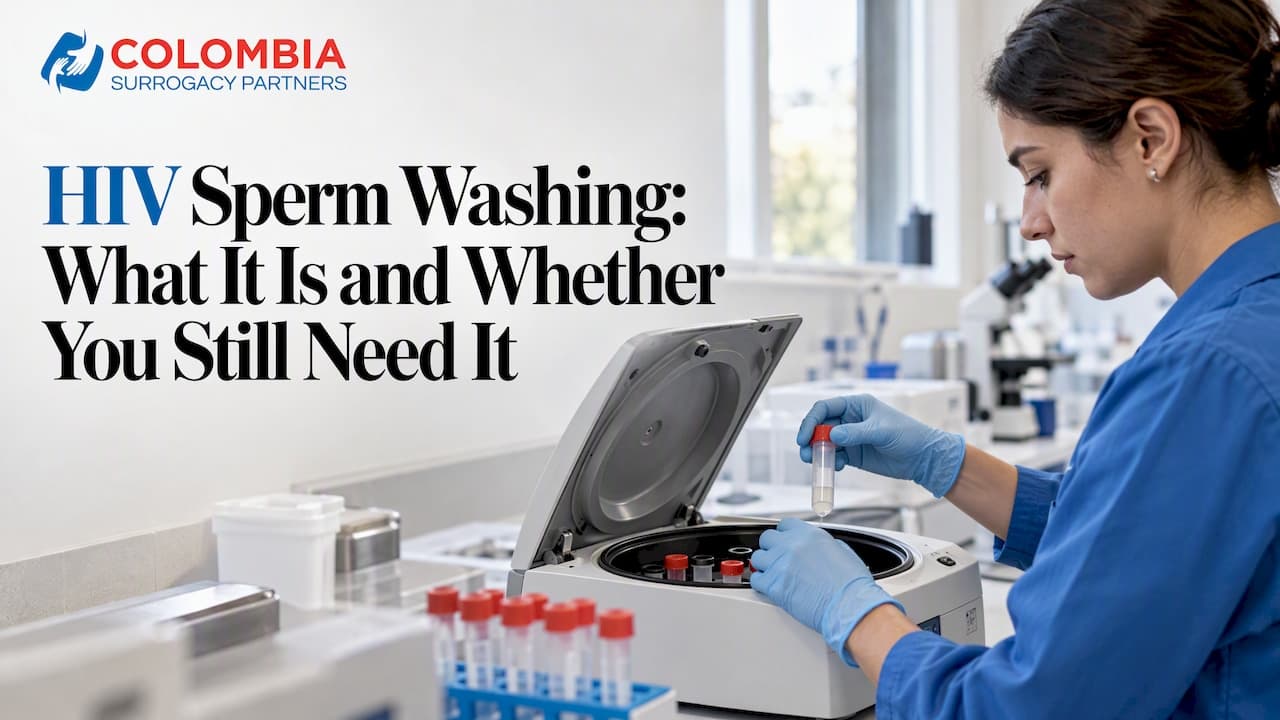
Sperm washing is a laboratory technique that separates sperm from the seminal fluid where HIV is carried, and it was once the main way for a man with HIV to conceive with an HIV-negative partner. In the United States it is no longer routinely recommended. Current federal guidance rests on sustained viral suppression with antiretroviral therapy (ART), which prevents sexual transmission when the viral load stays undetectable. This article explains how washing works, what the evidence says, where it still comes up, and how the question changes when you are building a family through surrogacy.
TL;DR
- Sperm washing separates sperm from seminal plasma and is followed by testing and insemination (IUI) or IVF. It was developed to lower HIV risk before ART was dependable.
- US federal guidelines now put the focus on sustained viral suppression (U=U), not on mechanical sperm processing, for most couples.
- If you are an intended parent with HIV, surrogacy is a realistic path. It needs an HIV specialist, a reproductive endocrinologist and legal counsel working together.
- The hardest part is often coordination and informed consent for the gestational carrier, not the medicine.
- Your own care team decides whether any lab step is needed in your case. Start that conversation with your HIV provider before you choose a clinic or agency.
Table of Contents
- What sperm washing is and how it works
- What the evidence says about safety and success rates
- Why US guidance moved away from routine washing
- When washing still comes up
- What changes when you use surrogacy
- Our perspective
- A practical sequence for intended parents with HIV
- Support for intended parents living with HIV
- FAQ
- Sources
What sperm washing is and how it works
Semen contains sperm cells and seminal plasma. HIV is found mainly in the plasma and in non-sperm cells, not in the sperm itself. That is the logic behind the technique, which IVI Fertility describes as the key assisted reproduction method for removing the virus from a sample.
The laboratory steps are usually these:
- Collection. The man provides a semen sample at the clinic.
- Separation. The lab uses centrifugation, often with a density gradient, to separate motile sperm from plasma and other cells. A swim-up step may follow. Reviews of sperm preparation methods show that the method chosen affects the quality of the final sample.
- Testing. A portion of the washed sample is tested for HIV RNA with a sensitive PCR assay. Only a sample that tests negative is used.
- Use. The sample is used for intrauterine insemination (IUI), or for IVF with ICSI, where a single sperm is injected into an egg.
The technique was pioneered by Semprini and colleagues in Italy, and clinical reviews note that it has been used in more than 1,000 cycles in published series.
What the evidence says about safety and success rates
The record is mixed in an interesting way. A 2021 review of sperm washing followed by IUI concluded that it is a safe and effective option for serodiscordant couples who want to conceive without transmitting the virus. European data from the CREAThE network, listed among the references in a Boston Medical Center trial record, reached a similar view of safety and efficacy.
There are also cautions:
- In 1990 the CDC reported a case of HIV transmission from an HIV-positive man to his partner through insemination, and recommended against using semen from HIV-infected men. Techniques and testing have improved since then, but the report explains why US clinics were slow to offer washing.
- Laboratory work has shown that viral RNA can persist after standard washing when semen contains very high concentrations of HIV-1. This is why post-wash PCR testing matters.
- HIV itself can affect semen. A well-cited study found that sperm parameters are significantly impaired in men with HIV and that the impairment correlates with CD4 count. A smaller sample after washing can mean lower pregnancy odds per cycle.
We do not quote a single success rate here. Pregnancy rates per cycle depend on the age of the partner who will carry, the sperm count after washing, and whether IUI or IVF is used. Ask any clinic for its own live-birth data per cycle, not only pregnancy tests, and for how many HIV-discordant cases it has handled.
Why US guidance moved away from routine washing
The change comes from treatment, not from a flaw in the lab method. Research shows that people with HIV who maintain an undetectable viral load on ART as prescribed do not transmit HIV to sexual partners. The CDC describes three landmark studies that support this.
The federal perinatal guidelines apply that evidence to family planning. For couples where the man has HIV, sustained viral suppression is the starting point, and the guidance sets out options that include timed condomless intercourse for couples who meet the criteria, with PrEP for the HIV-negative partner when indicated. In this framework, sperm washing is no longer the default. It remains a matter for individualized discussion, for example when viral suppression cannot be sustained or when a couple wants the extra margin.
The guidelines define sustained suppression as two plasma viral load measurements below the limit of detection, taken at least three months apart. They also advise that if conception does not occur within 12 months, or sooner when age or other factors call for it, a fertility workup including a semen analysis is appropriate.

The American Society for Reproductive Medicine takes a supportive stance as well. Its Ethics Committee opinion describes HIV as a serious but manageable chronic disease and says that many people with it want biological parenthood. Clinics with the right resources and expertise should offer services rather than withhold them.
Washing versus viral suppression at a glance
| Question | Sperm washing with IUI or IVF | Sustained viral suppression (U=U) |
|---|---|---|
| Main idea | Remove virus from the sample in the lab | Keep the virus undetectable in the body |
| Role in current US guidance | Individualized, not routine | Foundation of the guidance |
| What you need | Specialized lab, PCR testing, fertility clinic | Reliable ART, regular viral load tests |
| Main limitation | Technical, costly, fewer clinics offer it | Requires consistent adherence and monitoring |

When washing still comes up
A few situations keep the question alive:
- Viral load is not yet suppressed. Until two measurements below the detection limit are three months apart, your HIV specialist will not treat you as suppressed.
- A couple wants additional reassurance. Some choose a lab step even when suppressed. That is a shared decision with the care team.
- Fertility treatment is needed anyway. If IVF is already required for another reason, a clinic may discuss sample processing as part of the protocol.
- Older literature and online forums. Many pages still describe washing as the standard. They were written before U=U was widely adopted, so check their dates.
What changes when you use surrogacy
Surrogacy separates two questions that are often mixed up. The first is whether your sperm or eggs can be used. The second is how a gestational carrier is protected during the process.
In gestational surrogacy, embryos are created through IVF and transferred to the carrier. She does not provide the egg. For a man with HIV, the embryo is created in the lab, and the carrier never has sexual contact with the intended parent. The medical focus is therefore on your viral suppression and on the lab protocol your clinic uses, not on risk through conception.

The practical work is coordination. Guidance for these cases points to a multidisciplinary approach that includes an HIV specialist, an infertility expert and legal counsel, and notes that not every agency or clinic has the protocols or experience to manage it.
Informed consent for the carrier
A gestational carrier must be told of any medical risk material to her decision. When the intended parent is virally suppressed, HIV status itself often poses no risk to her, but the disclosure process still needs to be handled correctly. The ASRM opinion supports written clinic policies on what is disclosed to carriers and treating HIV with the same confidentiality and professionalism as any other chronic condition. Ask any agency how it handles this step in writing, who counsels the carrier, and whether the carrier has access to independent legal advice.
A note on other countries
Law varies by country. In the United Kingdom, for example, regulations changed in 2024 so that people with HIV can donate or provide eggs and sperm for surrogacy when their viral load is undetectable. That is a UK rule and does not describe US or Colombian law, but it reflects the same direction of travel in clinical thinking.
Our perspective
We work with intended parents who have heard conflicting things about HIV and family building. Many arrive expecting that they must pay for sperm washing or accept a long delay, because older web pages say so. Our view is that the first step is a conversation with your HIV specialist about your viral load history, not a procedure.
We also hold that being HIV-positive is not a reason to be turned away. The people on our team include legal and medical professionals, some with personal surrogacy experience, and we apply the same inclusive approach to every intended parent: gay and lesbian couples, transgender couples, heterosexual couples, singles, cancer survivors and people living with HIV. Parenthood is a fundamental right, and our job is to make the route practical and transparent.
We would add two cautions. First, do not choose an agency that treats your status as a problem to be hidden from the carrier; clear, respectful consent protects everyone. Second, ask whether the clinic has handled cases like yours. Our clinic is highly rated and works under the legal protections that apply to surrogacy in Colombia, and we have supported more than 60 live births. We still encourage you to compare programs on documented experience.
If you want to read more, our articles on how medical advances make parenthood possible for HIV-positive individuals and on surrogacy versus IVF for HIV-positive parents go deeper on the medical options.
— Florent Letronne, PhD
A practical sequence for intended parents with HIV
The order below keeps the medical and legal work from colliding.
- Confirm your viral suppression status. Ask your HIV provider for your recent viral load results and whether they meet the guideline definition of sustained suppression.
- Ask what the lab step should be. Request a clear answer on whether sperm washing is advised for you, or whether your clinic will use standard IVF procedures with your suppressed status.
- Choose a clinic with documented experience. Ask how many cases involving HIV it has managed and how the lab tests its samples.
- Decide how consent and disclosure will work. Get the policy in writing before matching begins.
- Start legal planning early. Parentage, travel and documentation rules differ between countries, so legal steps should run alongside the medical ones. Our surrogacy timeline explains why legal steps begin before IVF.
- Compare cost and structure. Our pages on affording surrogacy and international versus USA surrogacy explain how the two compare.
Support for intended parents living with HIV
We coordinate matching with surrogates, legal advisory, medical oversight and support through the whole surrogacy journey. We have a dedicated page for surrogacy for HIV-positive couples, and programs for gay couples, singles and international intended parents. If you are ready to talk through your situation, you can start from our main surrogacy page.
FAQ
Is sperm washing still used for HIV in the United States?
It is available at a few specialized centers, but it is not part of routine care. Federal guidance centers on sustained viral suppression with ART rather than lab processing. Your HIV specialist and fertility doctor decide whether it adds anything in your case.
Does sperm washing guarantee that HIV is not passed on?
No procedure can promise zero risk. Washing lowers the viral content of a sample, and labs test the washed sample by PCR before use. Research has shown that viral RNA can persist in some high-concentration samples, which is why testing is a required step.
Can a man with HIV have a biological child through surrogacy?
Yes. In gestational surrogacy the embryo is created in a lab and transferred to the carrier. The team usually includes an HIV specialist, a reproductive endocrinologist and legal counsel, and the carrier must receive full information as part of informed consent. Choose an agency and clinic that have handled this before.
Do I need to be undetectable before starting?
US guidance describes sustained suppression as two viral load results below the detection limit at least three months apart. Your care team should confirm that you meet it before fertility treatment begins, and they may set additional requirements.
Sources
- Prevention of HIV transmission with sperm washing followed by IUI (Carvalho, 2021)
- CDC MMWR: HIV-1 infection and artificial insemination with processed semen
- Elimination of HIV-1 from semen (Kuji et al.)
- The effect of HIV on sperm parameters (Nicopoullos et al.)
- Sperm washing overview, ScienceDirect Topics
- IVI Fertility: sperm washing and HIV
- Effects of sperm processing techniques on IVF pregnancy rates
- NIH Clinical Info: Reproductive options when one or both partners have HIV
- NIH Clinical Info HIV guidelines
- CDC: Clinical care of HIV
- ASRM Ethics Committee opinion: HIV and infertility treatment (2021)
- HFEA: donation and surrogacy for people living with HIV (UK)
- ClinicalTrials.gov: IUI in HIV-discordant couples