
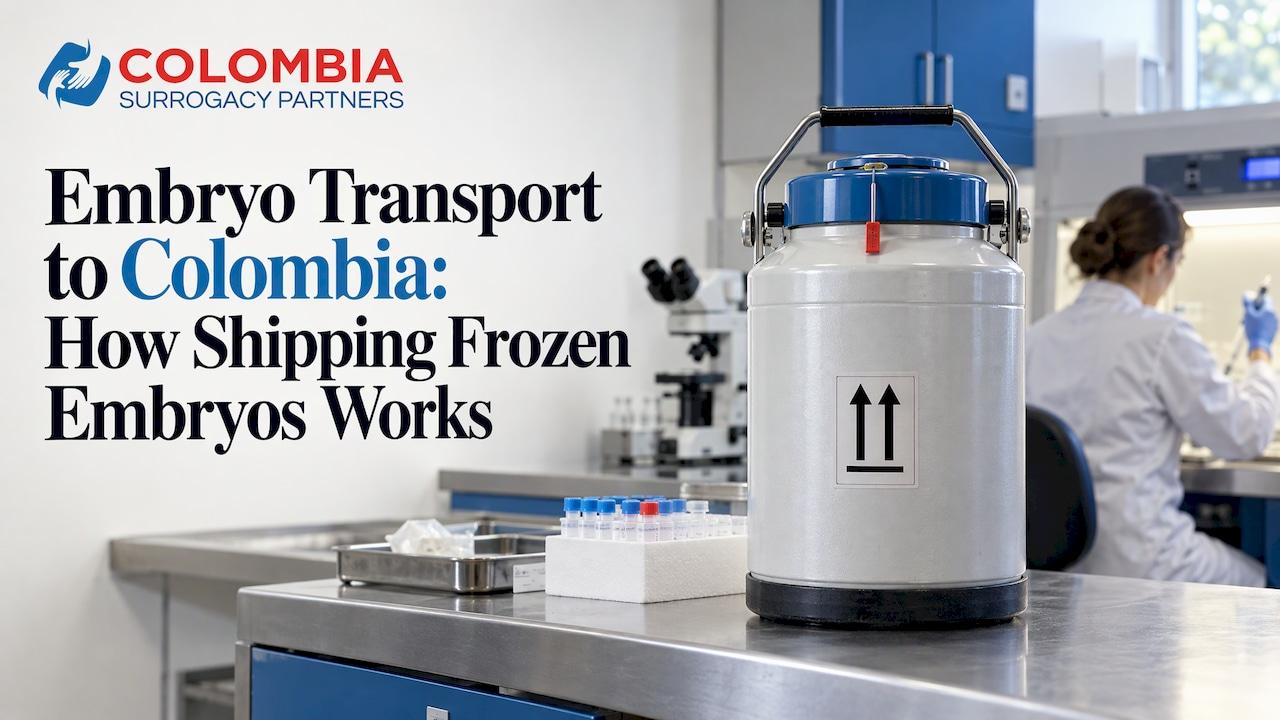
If you already have frozen embryos in the United States and want to use them with a surrogate in Colombia, they can be moved. The move is a clinic-to-clinic transfer: your U.S. clinic releases the embryos, a specialized cryogenic courier carries them, and a Colombian clinic authorized for assisted reproduction receives them and reports their entry to the authorities. This guide explains each step, what Colombian rules say, which documents to expect, and how to decide between shipping and other options.
TL;DR
- Embryo transport to Colombia is coordinated between your U.S. clinic, a cryogenic courier and a Colombian clinic that is authorized to perform assisted reproduction.
- Under a 2025 Ministry of Health circular, only authorized institutions may arrange the entry of embryos into Colombia, and they must report it to INVIMA within 24 hours.
- Embryos travel in dry liquid nitrogen shippers, with chain-of-custody records from pickup to lab verification.
- Budget separately for the courier, paperwork, storage and the surrogacy program itself, and ask every provider for an itemized quote.
- Some parents skip shipping altogether and compare it with having the surrogate travel to the clinic that holds the embryos.
Table of Contents
- What embryo transport to Colombia involves
- What Colombian rules say about moving embryos in
- Documents you should expect to handle
- The shipping process, step by step
- How to choose and coordinate a cryogenic courier
- How embryos are protected in transit
- What embryo transport costs and what it does not include
- Another option: bring the surrogate to the embryos
- Questions to settle before you ship
- Our perspective
- Planning embryo transport with a surrogacy team
- FAQ
- Sources
What embryo transport to Colombia involves
Many intended parents create embryos long before they choose a surrogacy destination. Some did IVF for a first pregnancy attempt, some froze embryos before cancer treatment, and some created embryos with a U.S. egg donor and a partner's sperm. When they later choose Colombia, the question is whether those embryos can go with them.
They can, but three parties have to agree:
- The sending clinic or storage facility, which holds the embryos and must release them.
- The receiving Colombian clinic, which must accept the embryos, review the medical records and handle import reporting.
- The courier, which supplies the shipping container, collects the embryos, transports them and documents every handover.
None of these steps is something you can do alone. You cannot simply buy a container and send embryos. The courier and both clinics each carry part of the responsibility, and the schedule only works when all three are aligned.
If you have not yet created embryos, the picture is different: with many programs, embryos are created in Colombia, so nothing needs to cross a border. Our article on how IVF powers the Colombia surrogacy journey explains that path.
What Colombian rules say about moving embryos in
Colombia regulates the entry and exit of human embryos specifically. In 2025 the Ministry of Health issued External Circular 030, which limits the arrangement of embryo entry or exit to authorized healthcare institutions habilitated to perform assisted reproduction. In practical terms, a private individual or an unlicensed intermediary cannot be the importer of record for your embryos.
The same circular sets out reporting duties. Institutions must notify INVIMA, the national drug and food surveillance institute, within 24 hours of an embryo entering or leaving the country. The report includes identification codes, the quantity of specimens and a declaration about donor eligibility.
The circular also tells clinics to verify donor-selection requirements and informed consent. It refers to Law 599 of 2000, Decree 1546 of 1998 and Resolution 3199 of 1998, and it explicitly requires that transport not violate Colombia's anti-trafficking provisions in Article 134 of the Penal Code.
What this means for you:
- Choose a receiving clinic that is authorized for assisted reproduction and ask it to confirm so in writing.
- Expect questions about how the embryos were created, who the gamete providers are and whether consent documents exist for each.
- If your embryos involve donor eggs or sperm, gather the donor screening and consent records early. They are the documents most likely to slow a file down.
Because rules can be updated, ask the receiving clinic to confirm the current requirements at the time you start, rather than relying on any article, including this one, as the final word.
Documents you should expect to handle
The exact list depends on your clinics and your embryos, but the paperwork usually falls into four groups.
Consent and release forms
You sign release forms with the sending facility and intake forms with the receiving clinic. Both sides need to see that the embryos' owners agree to the transfer. For couples who created embryos together, both partners normally sign. Parents who separated after creating embryos face the most complications here, so resolve ownership before you start.
Medical and laboratory records
The Colombian clinic will want the embryo records: how many embryos exist, their stage and grade, the date and method of freezing, and the lab that did it. It will also want infectious disease testing for the people who provided the gametes. Screening matters on the U.S. side as well. A January 2026 FDA warning letter to a fertility center stresses that donor screening must address communicable disease risks such as hepatitis B and C and West Nile virus, and that embryos with incomplete donor eligibility determinations must stay quarantined. If your embryos were made with donor gametes, ask your U.S. clinic to confirm that the eligibility determination is complete before you plan a shipment.

Import and customs documents
In most arrangements the receiving clinic handles the import filing, including a health certificate, lab results and a declaration of what the container holds. Colombian importers generally need to be registered. The U.S. Commercial Service notes that importers need a NIT and RUT registration with DIAN and must register on the VUCE platform. That is the clinic's responsibility, not yours, but it explains why you should not try to coordinate customs on your own.
Chain-of-custody records
The courier issues a manifest and tracks each handover. On arrival, the receiving laboratory compares the container's contents with the manifest and checks the shipper's temperature log. Keep copies of everything.
The shipping process, step by step
The order below is the one that avoids the most delays.
- Choose your Colombian clinic and program first. The receiving clinic must accept your embryos and records before anything is scheduled. If you are working with an agency, this is the stage where it confirms the clinic is a fit for your embryos and your family structure.
- Ask your U.S. clinic for its release process. Some clinics have a standard outbound transfer procedure, a fee and a notice period. Others have rarely done it. Ask early.
- Exchange records between clinics. The Colombian clinic reviews the embryo documentation and donor records and confirms it can accept the shipment.
- Sign consents and release forms on both sides.
- Book the courier once both clinics agree on a pickup window. The courier supplies the dry shipper, schedules pickup and sets the delivery plan.
- Pickup, transit and delivery. The courier collects the embryos from the U.S. facility, documents the handover and carries them to Colombia.
- Receipt and verification. The Colombian lab checks the contents against the manifest, inspects the shipper temperature and logs the embryos. The clinic files its entry report with INVIMA.
- Transfer planning. Only after the embryos are verified does the surrogate's cycle get timed for the embryo transfer.
On timing, the physical transit is the short part. The slow parts are paperwork and coordination between three organizations, so plan for several weeks from the first request to delivery, and longer if donor records need to be located or updated. Ask your clinics for their own realistic timelines in writing and build in a buffer before the surrogate's medication cycle begins.
How to choose and coordinate a cryogenic courier
A courier that specializes in reproductive specimens is not the same as a general shipping company. When you compare providers, ask these questions:
- Has the courier shipped to Colombia before? Experience with the Colombian receiving process matters more than a long general track record.
- Who supplies the container, and how is the shipper conditioned and tested before pickup?
- Is the shipment hand-carried by a person or sent as cargo? Hand-carried service usually costs more and may give tighter control. Ask what happens if a flight is delayed or cancelled.
- What chain-of-custody records do you receive? You should get a manifest, handover signatures and a temperature record.
- What does the quote include? Shipper rental, courier fee, export and import documentation, and brokerage should each be listed so you can compare quotes fairly.
- What is the liability and insurance position if the shipment is damaged or lost?
Ask your Colombian clinic which couriers it has already worked with. A courier the receiving lab knows will usually move through intake faster.
How embryos are protected in transit
Frozen embryos are shipped in dry shippers: insulated containers with absorbent material that holds liquid nitrogen in vapor form, so no free liquid is present. The American Society for Reproductive Medicine's 2022 laboratory guidance says embryos should be shipped in dry liquid nitrogen shippers that keep temperatures below -150°C. Reputable couriers monitor temperature through the journey and hold the container upright.
Two practical points help you judge a provider:
- Ask for the shipper's hold time and how it compares with the planned journey, including a margin for delays.
- Ask what happens at customs or airline checks. A good courier has a documented plan for presenting the container and paperwork without opening it.
No shipment carries zero risk, which is why your clinics and courier should document every step. Your reproductive endocrinologist can explain the risks relevant to your specific embryos, such as how many are in storage and whether any are your only remaining ones.

What embryo transport costs and what it does not include
Transport is one line among several. A realistic budget separates:
| Cost item | What to ask |
|---|---|
| Courier and shipper rental | Is the quote itemized by container size, route and service type? |
| Export release from the U.S. clinic | Does the clinic charge a transfer or administrative fee? |
| Documentation and customs | Who files the import documents, and is brokerage included? |
| Storage before and after transport | Are there storage fees at either end while you wait? |
| Receiving clinic intake | Is there a separate fee for receiving and verifying embryos? |
| The surrogacy program itself | Matching, legal work, medical care and support are separate from transport |
We do not publish a single transport price here because quotes vary with container type, distance, service level and whether the embryos are hand-carried. Use the table as a checklist and request written, itemized quotes from at least two couriers. For the larger picture of how program costs compare, see our guide to affording surrogacy.
Another option: bring the surrogate to the embryos
Shipping is not the only route. Some intended parents compare it with having the surrogate travel to the clinic where the embryos are already stored, for screening and transfer. That avoids the export and import process but adds its own questions:
- Does the clinic treat surrogates from abroad, and does it accept the surrogacy arrangement?
- Can the surrogate travel, and for how long? Transfer cycles usually need several monitoring appointments.
- Do the legal and parentage arrangements work in the place where the pregnancy would occur? In Colombia, the legal framework for surrogacy is a central part of the process, which we cover in Is surrogacy legal in Colombia?
- What are the combined costs of travel, lodging and extra clinic visits compared with shipping?
For most families who choose Colombia, the whole point is for the pregnancy and delivery to happen there under Colombian medical and legal supervision, so transport of the embryos to a Colombian clinic is the more direct route. The right answer depends on your embryos, your location and your timeline, so compare both with your clinic's input.
Questions to settle before you ship
Before you commit, work through this list with your agency and clinics:
- Are the embryos eligible to leave your current clinic, and is ownership documented?
- How many embryos do you have, and do you want to move all of them or only some?
- Were donor gametes used, and is the eligibility file complete?
- Will the Colombian clinic's own lab test thaw survival of a sample if that is part of its protocol?
- Is your surrogate matched, or will you wait for the embryos to arrive before matching?
- Does your country of residence recognize the parentage outcome? Our guide on whether Colombia surrogacy is legal in your country covers that question.
Our perspective
Parents come to us with frozen embryos for very different reasons. Some are same-sex couples who created embryos with a donor years ago, some are cancer survivors who froze embryos before treatment, and some are singles who started IVF and want a surrogacy path that is financially and legally workable. Each of them needs the same thing: a plan that does not put the embryos at risk.
We believe the strongest transport plan starts with the receiving clinic and the legal framework, not with the courier. Colombia operates under strict legal protections that support safety and altruism in surrogacy, and the rules on embryo entry exist to protect everyone involved. We therefore work with intended parents to confirm clinic authorization, documentation and consent before any shipping date is considered.
Our team includes legal and medical professionals, some with personal surrogacy experience, and we guide families through the whole journey, from the first consultation to post-birth considerations. Our approach is open to all intended parents, including LGBTQ+ individuals and couples, singles, heterosexual couples, cancer survivors and HIV-positive individuals. With over 60 live births to date, we have seen that careful sequencing of paperwork, records and consent is what keeps a transport on schedule.
If you are unsure whether to ship existing embryos or create new ones in Colombia, we can help you weigh both options based on your medical history and goals.
Florent Letronne, PhD
Planning embryo transport with a surrogacy team
If you want a single team to coordinate your Colombian clinic, legal steps and surrogate matching around your existing embryos, we can walk you through the process. We support international intended parents at every stage, and our surrogacy for international couples page explains how a journey works when you live outside Colombia.

We also work with singles, gay couples, lesbian couples, transgender couples and heterosexual couples. To start with your own embryos and questions, contact us through Colombia Surrogacy Partners.
FAQ
Can I ship my own frozen embryos to Colombia without a clinic?
No. Colombia's 2025 Ministry of Health circular says only authorized healthcare institutions habilitated for assisted reproduction may arrange the entry of embryos. The receiving Colombian clinic acts as the importer and files the report to INVIMA. Your role is to sign consents, supply records and choose a courier with the clinics' agreement.
How long does embryo shipping to Colombia take?
The flight itself is short, but the paperwork and coordination between clinics take most of the time. Plan for several weeks from your first request to delivery, and longer if donor records or consent documents need to be gathered. Ask both clinics for their own timelines before you set a date for the surrogate's cycle.
Are embryos safe during international transport?
Embryos travel in dry liquid nitrogen shippers designed to stay below -150°C, the threshold in ASRM's laboratory guidance, and the courier documents each handover. Risk is never zero, so ask about the shipper's hold time, the plan for delays and the courier's liability. Your reproductive endocrinologist can advise on risks specific to your embryos.
Do I have to ship embryos to use a Colombian surrogate?
No. You can create new embryos in Colombia, or compare shipping with having the surrogate travel to the clinic that stores your embryos. Which is best depends on how many embryos you have, whether they involve donor gametes, and your timeline and budget. A consultation with your clinic and surrogacy team can narrow it down.
What if my embryos were created with donor eggs or sperm?
Colombian rules require clinics to verify donor eligibility and consent, so you will need complete donor screening and consent records. U.S. regulators also expect donor eligibility determinations to be complete. Ask your current clinic for the donor file early, because missing records are a common cause of delay.
Sources
- Ministry of Health of Colombia, External Circular 030 of 2025
- INVIMA, legal compilation of Circular 30 of 2025
- Bogotá legal database, Circular Externa 030 de 2025
- U.S. Commercial Service, Colombia import requirements and documentation
- FDA warning letter to Conceive Fertility Center, January 2026