
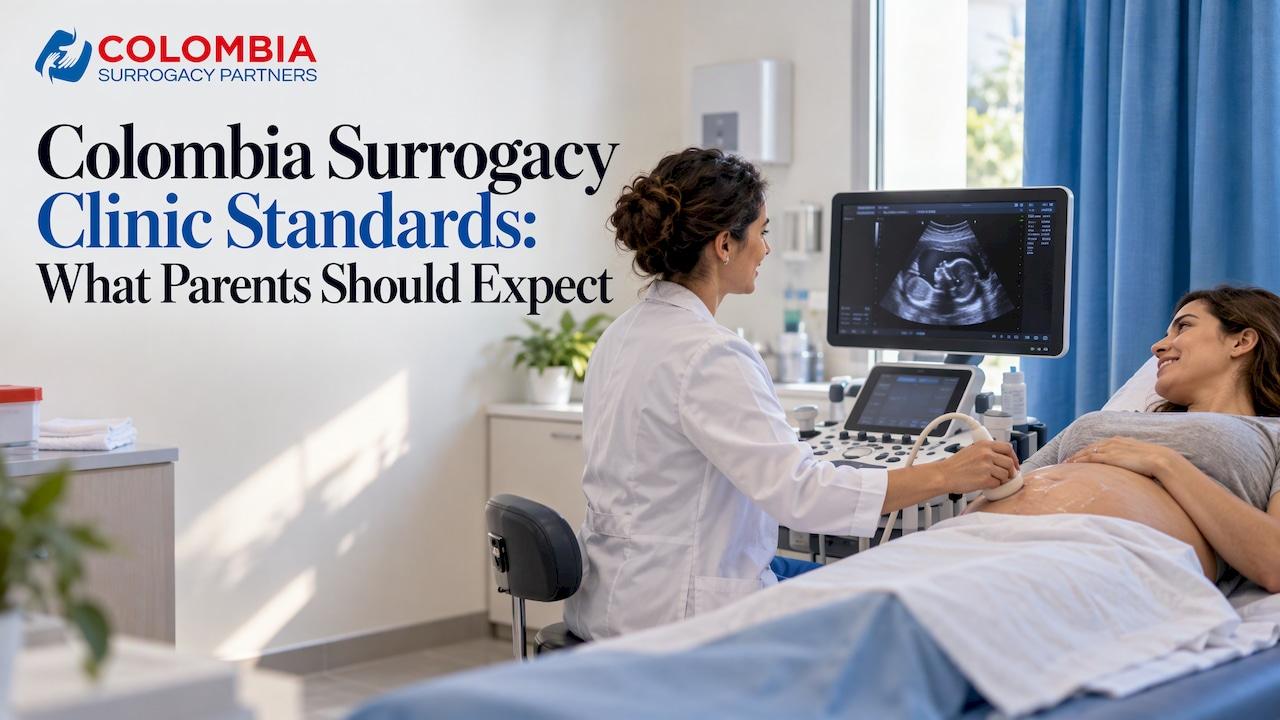
A good surrogacy clinic in Colombia screens donors and surrogates medically and genetically, operates under certified, registered fertility programs, protects every party with proper consent and contracts, and works with hospitals suited to high-risk obstetric and newborn care. Colombia has no single surrogacy statute, so these standards come from health regulations, court rulings and the practice of the program you choose. That makes the choice of program the most important decision you will make. At Colombia Surrogacy Partners, we coordinate the legal, medical and support sides of the journey for LGBTQ+ couples, heterosexual couples, singles and cancer survivors, and this guide explains what to look for.
TL;DR
- Colombia's rules for fertility programs are set in health regulation and court rulings, so the standards you can expect depend heavily on the program you work with.
- Reproductive programs must select healthy donors without genetic alterations that carry risks of congenital anomalies, under Decreto 1546 de 1998.
- Official registries, such as INVIMA's list of certified gamete and embryo banks, document which fertility centers meet sanitary and technical requirements.
- Informed consent, surrogate wellbeing and monitoring after the contract is signed are the areas where a strong program shows its quality.
- Hospital choice should be based on obstetric capacity, newborn care and clear coordination with your fertility clinic, and we handle these medical arrangements for our intended parents.
Table of Contents
- How Colombia regulates surrogacy and fertility clinics
- Medical standards a surrogacy clinic should meet
- Licensing and registries: how clinic credentials are documented
- Ethical safeguards: consent, contracts and the surrogate's wellbeing
- Choosing a hospital in Colombia for delivery and newborn care
- Practical issues U.S. parents should plan for
- A checklist for evaluating any Colombian surrogacy program
- Our perspective on clinic standards
- Start with a program built around your family
- FAQ
- Sources
How Colombia regulates surrogacy and fertility clinics
Intended parents often assume that a country with a thriving surrogacy sector has a dedicated surrogacy law. Colombia does not. The country's family welfare institute, the ICBF, stated in its Concepto 8 of 2020 that gestational surrogacy is neither permitted nor prohibited, because no laws or decrees govern it directly beyond court decisions, and that it should be regulated comprehensively.
What exists instead is a layered system:
- Health regulation governs reproductive medicine programs, including how donors are selected and how banks and clinics operate.
- Constitutional Court rulings set rights-based expectations, for example that agreements between clinics and gamete contributors must be presided over by special safeguards (Sentencia T-357 of 2022).
- Contracts and program protocols fill the rest. This is where a facilitator's legal team and a clinic's internal standards matter most.
For you, this means the label "Colombian clinic" tells you less than the specific program behind it. Two programs in the same city can differ in screening depth, legal structure, hospital relationships and the support you receive. The sections below show which standards to look for. For a wider view of the legal picture, see our explanation of whether surrogacy is legal in Colombia.
Medical standards a surrogacy clinic should meet
Donor and genetic screening
Colombia's Decreto 1546 de 1998, issued by the Ministry of Health, requires reproductive biomedicine programs to select healthy donors without genetic alterations that pose risks of congenital anomalies. It also requires programs to guarantee that condition while donors remain active in the program. In plain terms, screening is not a one-time form. It is a continuing obligation.
If you are using donor eggs or sperm, as many single parents, gay couples, lesbian couples and cancer survivors do, this is the standard that protects your future child's health. A strong program can explain how donors are screened, how often information is updated and what happens if new information emerges.

Surrogate screening
Surrogate eligibility is where a program's standards become most visible. Surrogates are generally expected to be in good health, to have children of their own and to pass medical and psychological evaluation. We describe the criteria in detail in our guide to surrogate requirements in Colombia. What you want from any program is consistency: the same criteria applied to every surrogate, documented, and reviewed by medical professionals rather than waived to speed up a match.

Embryo transfer and fertility care
A clinic's laboratory and clinical teams carry the medical outcome. For a reader who has already been through fertility treatment, such as a cancer survivor with stored material or a couple after unsuccessful cycles, the useful questions are practical:
- Who performs the transfers and the embryo laboratory work?
- How are stored embryos and gametes identified, tracked and transported?
- How is the surrogate monitored in the early weeks after transfer?
- Who is your medical point of contact when something unexpected happens?
Medical arrangements are part of what we coordinate for intended parents, so these questions are answered inside one program rather than across several unconnected providers.
Licensing and registries: how clinic credentials are documented
Colombia keeps official records on fertility centers. INVIMA, the national food and drug surveillance institute, publishes an observatory listing of certified gamete and embryo banks, updated to September 30, 2025. It documents the universe and sanitary status of certified banks, including fertility clinics, institutes and human reproduction centers, with details on compliance with technical and sanitary requirements.
For a U.S. intended parent, this is useful context. It shows that certification of the bank side of a fertility program is a matter of public record in Colombia, and it gives you a vocabulary for the documents a serious program works with: sanitary certification, technical compliance and the status of its gamete and embryo storage.
A few practical points for reading this kind of documentation:
- Certification applies to a specific center. Look at the name of the entity that holds the certification and match it to the center where your procedures will take place.
- Records are updated on a schedule. The listing carries a date, so confirm the current version when you plan your program.
- Certification covers the technical and sanitary side. Surrogate welfare, contracts and parentage are separate questions that depend on the legal structure around the clinic.
Our clinic is highly rated and operates under strict legal protections designed to keep the process safe and altruistic. Our team includes legal and medical professionals, some with personal surrogacy experience, who can explain the credentials behind each step of your program.

Ethical safeguards: consent, contracts and the surrogate's wellbeing
Standards are not only medical. The Constitutional Court's position that agreements with gamete contributors need special safeguards reflects a broader principle: consent has to be informed, specific and given freely. A 2026 comparative study from Universidad Simón Bolívar points to the areas where the framework is still developing: post-contractual mechanisms, prevention of human trafficking, the wellbeing of gestational carriers, institutional monitoring and breastfeeding. It concludes that regulation should secure the child's fundamental rights from birth, not simply formalize agreements between adults.
What does this mean when you choose a program? Standards that go beyond the minimum are valuable precisely because the framework leaves room for them. Look for these safeguards:
- Independent legal advice for the surrogate, so she understands the agreement and her rights before she signs.
- Psychological evaluation and support before, during and after the pregnancy.
- Altruistic structure. Colombian practice treats surrogacy as altruistic, and a program should be able to explain how that principle is built into its agreements.
- Clear written consent from every party for each medical step, in language they understand.
- Defined follow-up after birth for the surrogate's recovery and for the newborn's transition to you.
- Protection of the child's identity and parentage, with a plan for registration and travel documents.
Our approach is built on the belief that parenthood is a fundamental right and that safety and altruism must be part of the process, not an add-on. If you want to see how the full sequence works from consultation to birth, our overview of how surrogacy works in Colombia walks through each stage.
Choosing a hospital in Colombia for delivery and newborn care
The fertility clinic and the delivery hospital are often different institutions, and the second matters as much as the first. A surrogate's delivery, and your baby's first days, happen there. When we help intended parents think about hospital choice, these are the criteria that carry weight:
| What to consider | Why it matters |
|---|---|
| Obstetric capacity | Pregnancies after IVF, and especially twin pregnancies, benefit from a hospital experienced in higher-risk deliveries. |
| Neonatal care | Babies born early or with health needs need a neonatal unit on site or a tight referral arrangement. |
| Coordination with the fertility clinic | Records, embryo transfer details and prenatal results should move easily between teams. |
| Respect for intended parents | You should be able to be present, and the hospital should recognize you as the parents in its procedures. This matters for LGBTQ+ couples and single parents. |
| Language and communication | Updates in English, or a coordinator who translates, reduce stress and mistakes. |
| Proximity to your surrogate | A hospital near her home makes prenatal visits easier and safer in the final weeks. |
Many intended parents are surprised to learn how many logistical decisions sit behind a single birth: where the surrogate will deliver, who attends, how birth documentation is prepared and how soon the baby can leave the hospital. Working with a program that coordinates medical arrangements spares you from piecing this together from abroad.
Practical issues U.S. parents should plan for
Surrogacy abroad adds distance to an already emotional process. These are the practical points to plan for before you begin.
Time and travel
You will usually travel for key moments such as the birth, and you should allow time in Colombia afterward for registration and your child's travel documents. Flexible work arrangements and a travel budget that includes a buffer for extra days are worth setting up early.
Genetic link
Surrogacy programs in Colombia commonly expect at least one intended parent to have a genetic link to the child, which can shape which pathway suits you. Single parents, same-sex couples and cancer survivors should discuss gamete options early so the plan fits their situation. Our service pages for gay couples, lesbian couples, transgender couples and singles explain how programs are structured for each.
Age and medical history
Age limits and health history affect eligibility and options. Cancer survivors in particular benefit from early coordination between their oncology team and a fertility specialist. Your own doctor should confirm that pregnancy by a surrogate, and any use of stored material, is appropriate for your medical history. Our article on surrogacy age limits for Colombia applicants covers how age affects eligibility.
Legal recognition at home
Parentage recognition and citizenship procedures depend on your country. Before you begin, speak with a family law attorney in your home state who handles international surrogacy, and read about how Colombian surrogacy is viewed in your country. Our team supports the legal side in Colombia and helps you prepare for what comes after the birth.
Cost comparison
Colombia can offer significant cost savings compared with domestic U.S. programs, and our own results include over 60 live births. For a side-by-side view of the two routes, see international versus U.S. surrogacy.
A checklist for evaluating any Colombian surrogacy program
Use this list as you speak to programs. It turns the standards above into questions you can ask in a first call.
- Medical team: Who are the physicians and embryologists, and how are donor and surrogate screening results documented?
- Certification: Which center holds the sanitary certification for the laboratory and storage that will handle your material?
- Surrogate welfare: How is the surrogate supported psychologically and legally, and what follow-up does she receive after birth?
- Contracts: Are agreements reviewed by lawyers, and are they explained to each party before signing?
- Hospital plan: Which hospital will be used for delivery, and what neonatal care is available?
- Communication: Who updates you, how often, and in which language?
- Inclusivity: Does the team have direct experience with LGBTQ+ parents, singles, cancer survivors and HIV-positive intended parents?
- After birth: What help is provided with registration, documents and travel home?
The last two questions are where we put particular emphasis. Our commitment to inclusivity for LGBTQ+ individuals, couples and singles is central to how our programs are designed.
Our perspective on clinic standards
Standards in Colombian surrogacy are best understood as a partnership between regulation and practice. The country's health rules require careful donor selection, and its Constitutional Court has demanded safeguards in agreements, but a dedicated surrogacy statute is still developing. That puts weight on the program you choose.
We believe parenthood is a fundamental right, and that a program should be judged by how it treats everyone involved. For intended parents, that means medical coordination, legal guidance and honest communication from the first consultation. For surrogates, it means a safe, altruistic and supportive environment. For the child, it means a process designed around the child's wellbeing from birth.
Our team includes legal and medical professionals, some with personal experience of surrogacy, and our clinic is highly rated and operates under strict legal protections. Intended parents come to us as gay couples, lesbian couples, transgender couples, heterosexual couples, singles, cancer survivors and HIV-positive individuals, and our programs are built for each of them. When a family chooses us, they are choosing a program whose standards are meant to hold at every stage, from the first appointment to the birth.
Florent Letronne, PhD
Start with a program built around your family
If you are comparing Colombian programs, the most useful next step is a conversation about your own situation: your family structure, medical history, timeline and where you live. We offer dedicated programs for international couples, heterosexual couples and the other families described above, each coordinated through legal advisory, medical oversight and support from matching through birth.

You can learn more about our full program on our main page or request an appointment to speak with our team.
FAQ
Does Colombia have a specific law for surrogacy clinics?
No single statute governs surrogacy directly. The ICBF has noted that gestational surrogacy is neither permitted nor prohibited, with court rulings filling much of the gap. Clinics operate under general reproductive health regulation, which is why a program's own protocols and legal structure carry so much weight.
How is donor screening regulated in Colombia?
Decreto 1546 de 1998 requires reproductive biomedicine programs to select healthy donors without genetic alterations that pose a risk of congenital anomalies. Programs must also guarantee that condition while donors remain active. A good program can explain how this works in practice for your chosen donor.
What should I look for when choosing a hospital for delivery?
Focus on obstetric experience with IVF pregnancies, neonatal care, smooth communication with the fertility clinic and respect for intended parents of every family type. Proximity to the surrogate also matters. We coordinate these medical arrangements as part of our programs.
Can single parents and LGBTQ+ couples use Colombian surrogacy programs?
Yes. Our programs are open to gay, lesbian and transgender couples, heterosexual couples and singles, along with cancer survivors and HIV-positive intended parents. Each pathway has its own details, particularly around gamete sourcing, so an early consultation helps you plan.
What happens after the baby is born?
After birth, the focus turns to the surrogate's recovery, your child's registration and the documents needed to travel home. Parentage recognition depends on your country, so consult a family law attorney in your home state before you begin.
Sources
- Colombian Constitutional Court, Sentencia T-357 de 2022
- Ministry of Health of Colombia, Decreto 1546 de 1998
- INVIMA, certified gamete and embryo banks, updated September 30, 2025
- Universidad Simón Bolívar, Surrogacy in Colombia: Contributions to a Transactional Framework (2026)