
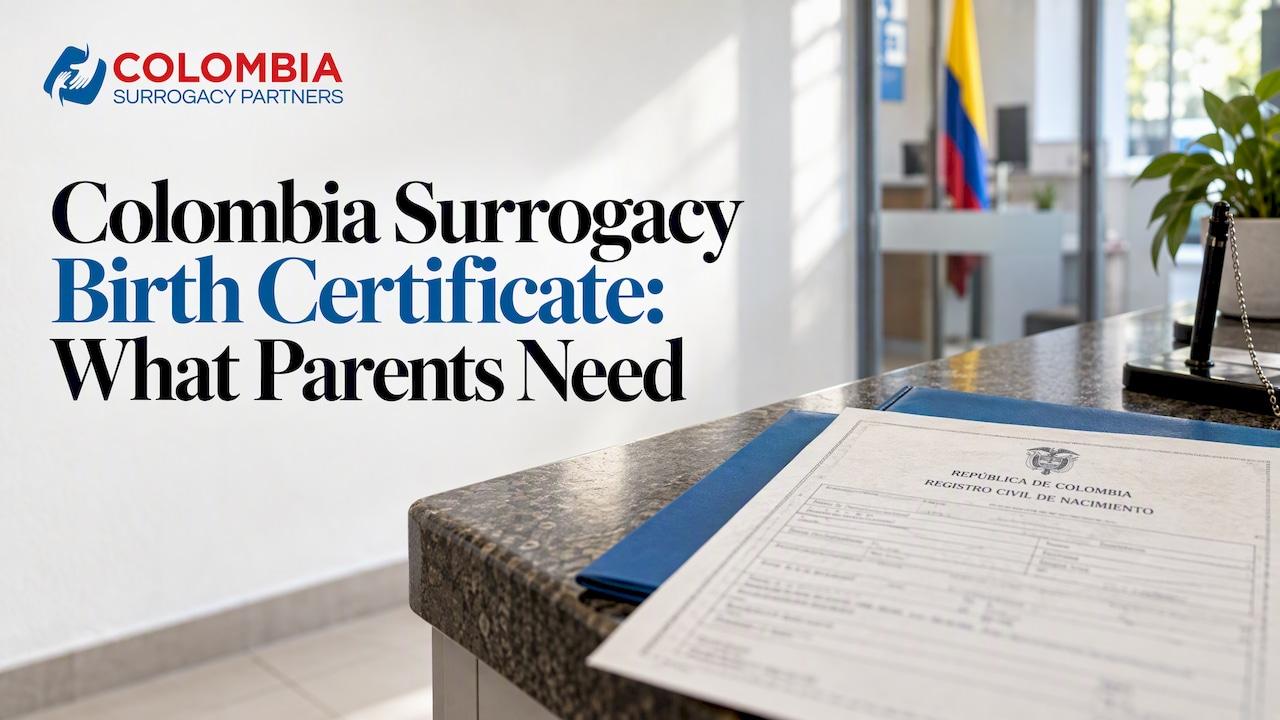
After a surrogacy birth in Colombia, the first birth record is built from the hospital's live birth certificate, and it names the woman who gave birth as the mother. Intended parents are not on that first record by default. Getting your names recorded depends on a court process, and getting your baby home depends on a separate step: proving U.S. citizenship to the U.S. Embassy in Bogotá. This guide explains each document, the order they come in, and what to check at every stage.
TL;DR
- The initial Colombian certificate of live birth records the surrogate's identity and does not mention surrogacy, according to HCCH research.
- Colombia has no specific statute on surrogacy, so recording intended parents usually runs through a court order handled case by case.
- A Colombian birth certificate does not make a baby a U.S. citizen. Citizenship depends on the U.S. Immigration and Nationality Act and on your genetic or gestational connection to the child.
- For the trip home you apply for a CRBA and a U.S. passport together, using the long-form Colombian birth certificate.
- Plan the legal steps before embryo transfer, not after the birth.
Table of Contents
- What the Colombian birth certificate shows after surrogacy
- How a newborn is registered in Colombia
- A Colombian birth certificate is not U.S. citizenship
- From birth certificate to CRBA and passport
- Before you leave Colombia with your baby
- Our perspective: plan the documents first
- How we support the document stage
- Common problems and how to prevent them
- Where to learn more
- FAQ
- Sources
What the Colombian birth certificate shows after surrogacy
Two documents are easy to confuse. The first is the certificate of live birth (certificado de nacido vivo), which the hospital or attending professional completes. The second is the civil registry of birth (registro civil de nacimiento), the official record and the source of the birth certificates you later request.
The HCCH report on registering births of children born through surrogacy found that in Colombia the initial certificate of live birth records the surrogate mother's identity and does not indicate a surrogacy arrangement. The same source explains that adding intended parents typically requires a court order or judicial decree amending the record, because no specific legislation regulates surrogacy.
The Civil Registration and Vital Statistics resource on Colombia says the same thing from another angle: the law does not regulate surrogacy or specify how birth registrations should be amended, so courts address cases individually.
In practice, this means three things for you:
- Expect the surrogate's name on the first record. This is the normal starting point, not a sign that something went wrong.
- The amended record is what carries your names. Treat the court decision as the center of your legal plan.
- Outcomes depend on the paperwork behind them. The agreement, the medical records and the evidence of your genetic or gestational links all feed the court's review.
Because the law is unsettled and courts rule case by case, a general article cannot tell you how a specific judge will rule. A Colombian family-law attorney who handles surrogacy matters should confirm the current practice for your case.
What a surrogate birth certificate looks like
Readers often ask what the document looks like. The short answer: a standard Colombian civil registry record, with no field that says "surrogacy." The first version lists the woman who gave birth. After a court order is applied, the record is amended to show the intended parents. Ask your attorney to confirm exactly which version you hold at each stage, and request the long form, since that is the version the U.S. Embassy asks for.
How a newborn is registered in Colombia
The sequence after a birth is straightforward when everything is prepared in advance.
- The hospital issues the certificate of live birth. The Colombian Ministry of Health's instructions say it must be filled out without abbreviations, erasures or corrections to be accepted as the basis for civil registration. A typo in a name or date can stall everything that follows.
- The birth is entered in the civil registry. This produces the registry record from which certified copies are issued.
- The court process addresses parentage. This is where the intended parents' names are established, as described above.
- You request certified copies. The long-form version is the one you will need for U.S. consular services.
What to verify before the certificate is issued
Before anyone signs or files, read the document slowly. Check:
- Spelling of every name, including the baby's chosen names and any second surname.
- Date and time of birth against the hospital's records.
- Place of birth and the hospital's details.
- Whether the information matches the passports you will present.
Corrections after issuance are slower and more expensive than catching a mistake at the hospital. This is one of the reasons we send a coordinator and a bilingual legal contact to the birth city instead of leaving parents to sort out hospital paperwork alone.
If registration is delayed
Sometimes registration does not happen in the first days. Late registration is possible. According to the Colombian Ministry of Justice, it requires a formal request and the testimony of two witnesses with direct knowledge of the birth. For a surrogacy birth, this is a route to avoid. Delays add time in Colombia, and every extra week is a week away from home with a newborn.

A Colombian birth certificate is not U.S. citizenship
This is the point that surprises many American parents. Civil registration in Colombia and nationality in the United States are separate legal matters. Having your names on a Colombian record does not by itself make your baby a U.S. citizen.
The U.S. Department of State explains that citizenship at birth for a child born abroad depends on meeting the requirements of the Immigration and Nationality Act, and that at least one parent must be a U.S. citizen at the time of birth, as set out in its guidance on assisted reproductive technology and surrogacy abroad. A qualifying parent is a U.S. citizen who is the genetic father, the genetic mother, or the gestational and legal mother, or a U.S. citizen who is married to a genetically or gestationally connected parent at the time of birth.
What that means for different families:
| Family situation | What the State Department test looks at |
|---|---|
| U.S. citizen father who is the genetic father | Genetic connection to the child |
| U.S. citizen mother using her own eggs | Genetic connection to the child |
| U.S. citizen married to a genetically connected parent | Marriage at the time of birth plus the other parent's connection |
| Single U.S. citizen using donor egg and donor sperm | No genetic or gestational connection, so the test is not met on these facts |
The last row matters. If neither parent is genetically or gestationally connected, citizenship at birth through the INA may not be available, and you need an immigration attorney before you begin. If you are an LGBTQ+ couple, the genetic link of each parent and your marital status at the time of birth are the facts that decide the analysis. Our page on the role of intended parents' genetic materials explains how this is planned.
The same State Department page notes that DNA testing is often the best way to prove a genetic relationship to a child born through surrogacy. Plan for a test during your stay in Colombia and ask the Embassy for its current procedure.
From birth certificate to CRBA and passport
The Consular Report of Birth Abroad (CRBA) is the U.S. document recording that your child acquired citizenship at birth. You apply for it with the U.S. passport at the same time. The U.S. Embassy in Colombia says parents should apply for a CRBA and passport together, and lists what to bring:
- The child's long-form Colombian birth certificate.
- The parents' proof of identity and U.S. citizenship.
- Evidence of the U.S. citizen parent's physical presence in the United States.
The Embassy's birth page also says parents must present the Colombian birth certificate as an original plus one notarized copy. Check that page before your appointment, since the Embassy updates requirements and fees.
What the CRBA does and does not prove
A CRBA documents citizenship at birth. According to the State Department, it is not proof of the identity of the child's legal parents. That distinction shapes what you do once you are home. Our guide CRBA vs. passport: what each proves for a surrogacy baby goes into it in more detail.
Documents in another language
If you ever need to register a foreign-issued birth record in Colombia, the Ministry of Foreign Affairs states that documents in a language other than Spanish need an official translation and an apostille or legalization. Parents with documents from their home state, such as marriage certificates, should ask their attorney which of them will be needed and prepare apostilles before they travel.
Before you leave Colombia with your baby
The Department of State advises several steps before departure. In its guidance on surrogacy abroad, it says to obtain a U.S. passport for a U.S.-citizen child under 16, to obtain approval from all legal parents or guardians, which includes a surrogate who is the legal mother, and to consult a lawyer about custody or guardianship.
U.S. citizens must also enter and leave the United States on a U.S. passport, even when they hold another nationality, according to the U.S. Embassy in Colombia. Your baby's passport is therefore the document that gets you through the airport, not the Colombian certificate.
A practical checklist for the final week:
- Long-form Colombian birth certificate, original and notarized copy.
- Court documentation showing the amended parentage record, where applicable.
- DNA test results, if the Embassy requests them.
- CRBA and passport applications, completed and scheduled together.
- Written consent or approvals required from the legal parents, as your attorney advises.
- Pediatric records and the newborn's first medical documentation.
- Copies of everything, stored digitally and on paper in separate bags.
Our perspective: plan the documents first
We see the same pattern with families who arrive prepared and families who arrive worried. The prepared families treated the paperwork as part of the medical plan from the first consultation. They knew before the transfer who would be on the first birth record, how the court process would proceed, which genetic connection would support the citizenship claim, and what the Embassy would ask for.
Three principles guide how we advise intended parents:
- Start from citizenship, not from the certificate. Which parent is genetically connected, and whether you are married at the time of birth, shapes your options. We raise this in the first conversation, with each family type: gay couples, lesbian couples, transgender parents, heterosexual couples and singles.
- Be honest that Colombian law leaves gaps. There is no dedicated surrogacy statute, and courts decide individually. Our role is to coordinate legal experts and medical professionals so your case is documented clearly, and to tell you plainly what is settled and what is not. Our overview of the legal framework in Colombia covers the background.
- Treat the surrogate's role with respect. The process works within an altruistic, legally protected framework, and the surrogate's consent matters at every stage, including at the end when the legal parentage record is amended.
Parenthood is a fundamental right, and no family should leave Colombia unsure whether their documents will hold. Our team includes legal and medical professionals with personal surrogacy experience, and we would rather answer a hard question in month one than have you discover it at the airport.
— Florent Letronne, PhD
How we support the document stage
If you are ready to talk about your case, Colombia Surrogacy Partners coordinates matching, legal guidance, medical oversight and the practical steps after the birth. International families can start on our page for international couples, where we outline how the journey works from abroad.

We do not publish a fixed price for the program, so the first consultation is where we review your situation and explain what your plan would include. Our guide to affording surrogacy explains how families think about cost.
Common problems and how to prevent them
A name or date error on the live birth certificate. The Ministry of Health's rule on no corrections means a flawed form may need to be reissued. Have your coordinator read the form with you before it is filed.
Assuming the Colombian record settles citizenship. It does not. Settle your citizenship analysis before the embryo transfer, with an immigration attorney if you are unsure about your genetic link or marital status.
Booking flights too early. Court steps, DNA testing and consular appointments each take time that depends on the case. Leave a flexible return date, and confirm current waiting times with the Embassy.
Missing consent from the legal mother. Because the surrogate is the legal mother on the first record, the State Department advises obtaining approval from all legal parents or guardians before the child leaves the country. Ask your attorney to document it.
Skipping the follow-up at home. A CRBA is not proof of who the legal parents are. Ask a family attorney in your state whether you need a further step, such as a court order or adoption, to secure your legal relationship with your child. Requirements differ by state.

Where to learn more
If you are earlier in your research, our step-by-step guide to how surrogacy works in Colombia and our overview of the legal process show where the birth certificate fits in the full timeline. Families comparing destinations may also want our comparison of international versus U.S. surrogacy, and readers checking whether their home country recognizes the arrangement can read whether Colombia surrogacy is legal in your country.
FAQ
Who is listed on the birth certificate after surrogacy in Colombia?
The initial record lists the surrogate, who is treated as the mother when she gives birth. Intended parents are usually added through a court order that amends the record. Ask your Colombian attorney how this will proceed in your case, since courts decide individually.
Does the birth certificate show that the baby was born through surrogacy?
According to HCCH research, the initial Colombian certificate of live birth records the surrogate's identity and does not indicate a surrogacy arrangement. The document therefore carries no surrogacy label. The legal steps that follow are documented in the court file.
Is my baby automatically a U.S. citizen if born in Colombia?
No. Colombian registration and U.S. nationality are separate matters. Under the State Department's guidance, at least one U.S. citizen parent must have the required genetic or gestational connection, or be married to such a parent at the time of birth. Speak with an immigration attorney if your situation is unclear.
What do I need to get a CRBA and passport in Bogotá?
The Embassy asks for the long-form Colombian birth certificate, the parents' identity and citizenship evidence, and proof of the U.S. citizen parent's physical presence in the United States. You apply for both documents together. Check the Embassy's birth page for current fees and appointment steps.
Can we leave Colombia before the court process finishes?
That depends on your case, your attorney's advice and the documents the Embassy accepts. The State Department advises getting approval from all legal parents, including a surrogate who is the legal mother, and consulting a lawyer about custody or guardianship before departure. Do not book a fixed flight until your attorney confirms the timeline.
Sources
- HCCH: Registration of births of children born through surrogacy
- CRVS: Colombia birth registration, specific situations
- Colombian Ministry of Health: Certificado de nacido vivo
- Colombian Ministry of Justice: late birth registration
- Colombian Ministry of Foreign Affairs: birth certificate civil registration requirements
- U.S. Embassy in Colombia: Birth
- U.S. Department of State: ART and surrogacy abroad